

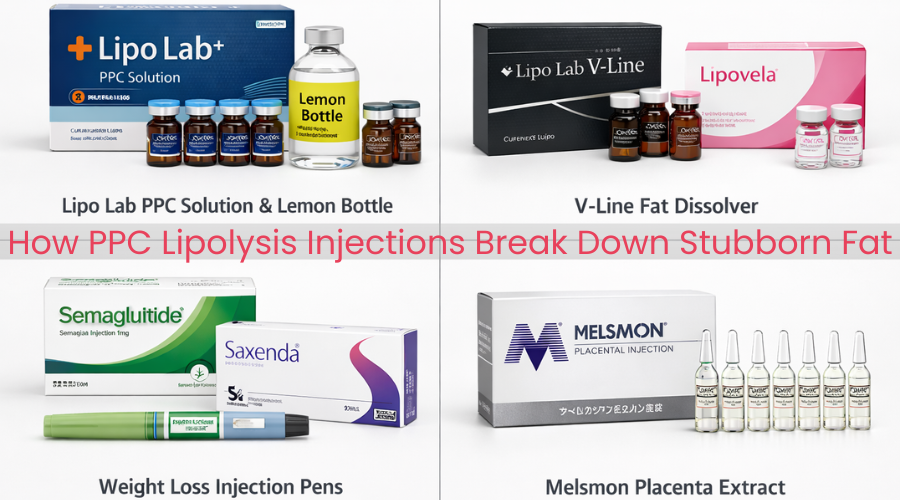
The non surgical fat reduction market is projected to climb from $1.49 billion in 2025 to $2.88 billion by 2030, maintaining a compound annual growth rate that would make any investor's ears perk up . Patients are streaming through clinic doors, not asking if they can eliminate their bra bulge or flank fat without a scalpel, but how soon they can schedule the appointment. For cosmetic enhancement startups navigating this sudden one treatment sits at the intersection of low cost and high demand: PPC lipolysis injections.
But here's the problem. Most providers can't explain how these injections actually work beyond mumbling something about "melting fat." And in an industry where one bad result can burn down a glorious reputation of even a well-established clinic, having vague assumptions regarding this industry is not the correct business strategy for a startup clinic. It's your shield against liability and your sword for closing consultations.
Let us not get confuse by medical words and discuss plainly about what happens when that needle pierces the skin layer.
The body already knows how to perform lipolysis. When you restrict calories or hit the treadmill, hormones signal fat cells to release their stored triglycerides. The cell shrinks, sure, but it remains very much alive, waiting patiently for your next ice cream binge to fill itself back up. This is why fat reduction of a specific body area through exercise is largely a myth. The truth is, you cannot tell your body which fat cells to empty.
PPC lipolysis injections operate through an entirely different mechanism, called adipocyte lysis by researchers. This isn't shrinking of fat cells. This is destruction. The fat cell dies .
The two active ingredients driving this process are phosphatidylcholine (PPC) and deoxycholate (DC) . Phosphatidylcholine, a phospholipid found naturally in cell membranes, demonstrates remarkable selectivity for mature adipocytes. When injected, it disrupts the cell's outer wall, causing the fatty contents to spill outside the cell. Deoxycholate, a bile salt, acts as a detergent. It solubilizes those released lipids and further degrades cell membranes. Together, they don't just inconvenience the fat cell. They eliminate it .
But the injection technique also matters and has an impact on the success rate of the treatment. A skilled competent practitioner knows that Deoxycholate is less selective than PPC. It will happily dissolve any cell membrane it encounters, which is precisely why injection depth and technique matter enormously. Inject too superficially into the dermis, and you're courting skin necrosis. Inject properly into subcutaneous fat, and the surrounding vasculature and connective tissue remain largely undisturbed while adipocytes (fat cells) meet their demise.
The results are permanent, and this is what really attracts and catches the attention of the customer. The body does not regenerate new fat cells in adulthood. Once destroyed, those adipocytes are gone forever. Weight gain will expand the remaining cells, but the treated area will always carry fewer of them. This is a conversation you must have during consultation, by the way. Nothing erodes trust faster than a patient who regains weight elsewhere and blames your treatment for "not working."
The Lipo Lab injection how to use methodology follows principles common to most PCDC formulations, though specific products vary in concentration and supporting ingredients. The process begins with mapping. Using a surgical marker, the clinical professional grids the treatment area at one- to two-centimeter intervals . This spacing isn't arbitrary. Too close and you risk overwhelming the lymphatic system's ability to clear cellular debris. Too far apart and you leave untreated pockets that create contour irregularities.
A 30-gauge needle attached to a 1mL syringe delivers approximately 0.5cc per injection point into the subcutaneous skin area. The sensation for the patient? Often described as a deep warmth or mild burning. This irritation is reduced with topical lidocaine or compounded anesthetic in the solution itself. Post-injection, the area swells. Significantly. Sometimes alarmingly, from the patient's perspective. This swelling, paired with erythema and tenderness, is not a side effect in the conventional sense. It is the visible manifestation of the inflammatory cascade actively clearing dead adipocyte debris. If the patient becomes alarmed by the swelling the correct way to frame it is to simply say, "The swelling means it's working."
Patients require anywhere from two to four sessions spaced four to six weeks apart for best results . The waiting period is necessary and should never be skipped. The body needs time to process and excrete the dead fat. Rushing the next session before lymphatic clearance completes does not accelerate results but only increases complication risk.
Aftercare is relatively simple and straightforward. Ice for the first 24 hours to manage swelling. No saunas, steam rooms, or strenuous exercise for 48 to 72 hours. Avoid NSAIDs like ibuprofen or aspirin that blunt the inflammatory response you just paid to create. And under no circumstances should the patient massage the treated area. Massage can force the solution into unintended tissue planes .
Now we enter territory where business savvy meets legal survival. If you plan on opening a cosmetic enhancement center, ignoring this section can have serious consequences for the legality of your operation. The FDA has approved exactly one injectable fat-dissolving drug: Kybella, a synthetic deoxycholic acid formulation indicated specifically and exclusively for fat of the double chin region . That's it. Everything else, the PPC/DC combinations used on abdomens, flanks, arms, and thighs, operates in the realm of off-label use.
This is not automatically illegal or unethical. Physicians prescribe medications off-label routinely across every medical specialty. But it demands heightened responsibility. The FDA has explicitly warned consumers about adverse events from unapproved fat-dissolving injections, including permanent scarring, serious infections, skin deformities, cysts, and painful nodules . Some of these complications occurred when unlicensed personnel performed injections or when patients purchased products online and injected themselves. Others happened in legitimate clinics using improperly sourced product.
So what should be your procurement plan? We recommend sourcing exclusively from clinical grade products obtained through 503A compounding pharmacies or authorized medical distributors. Never, under any circumstances, purchase injectables from online marketplaces, overseas websites offering "wholesale" pricing, or any channel that cannot provide a verifiable supply chain pedigree. All your cost savings will go into defending against a lawsuit the moment a patient develops an atypical mycobacterial infection from a contaminated product.
Furthermore, the absence of FDA approval for body applications means your informed consent process must be bulletproof. Document that patients understand they are receiving an off-label treatment. Document the expected side effects. Document the alternative options including surgical liposuction and device-based modalities. Document, document, document.
A multi-country survey of 17,376 patients undergoing 56,320 injection lipolysis sessions offers the most comprehensive safety data available . The findings are instructive for any startup building treatment protocols.
The vast majority of negative events were mild and self-limiting. Expected issues range from swelling, to bruising and tenderness at injection sites. These resolved without intervention. More notable findings: 12.34% of patients expressed disappointment at less-than-expected aesthetic results. Persistent pain beyond two weeks occurred in 0.015% of patients. Hyperpigmentation affected 0.0021%. And contour irregularities requiring additional correction happened in roughly 0.0018% of cases .
Critically, the study reported zero deaths. Zero hospitalizations. Zero cases of skin loss, ulceration, or atypical infection when procedures were performed by licensed physicians using proper technique .
What distinguishes the 12% disappointment cohort from the satisfied majority? Inadequate pretreatment education. Patients who expected one session to eliminate a decade of abdominal fat were predictably unhappy. Patients who understood the gradual, multi-session nature of the treatment reported satisfaction rates exceeding 85%.
This data point deserves your attention. The most common "complication" isn't medical at all. It's communication failure. Every dissatisfied patient represents not just lost revenue but negative reviews and word-of-mouth damage that disproportionately harms startups lacking established reputations. Spend an extra five minutes setting expectations. It costs nothing and protects everything.
More serious complications, while rare, cluster around three avoidable errors. First, injecting too superficially deposits solution into the dermis rather than subcutaneous fat, risking skin necrosis. Second, using concentrations exceeding clinical guidelines amplifies the detergent effect of deoxycholate, damaging surrounding tissue. Third, inadequate sterile technique introduces pathogens into a warm, nutrient-rich environment perfect for bacterial proliferation. Each of these is preventable with proper training and protocol adherence.
Lipolysis injection cost to the provider depends entirely on sourcing. Clinical-grade PCDC formulations obtained through legitimate compounding pharmacies typically range from $15 to $40 per vial at wholesale, with each vial treating a defined area depending on size. The abdomen might require two to three vials per session. The double chin, often just one. These are estimates rather than quotes, as pricing varies by region and vendor relationships.
The pricing for treatment sessions follows predictable tiers. Small areas like the submental region command $400 to $600 per session in most U.S. areas. Medium areas like arms or inner thighs range from $600 to $900. Large areas including the abdomen and flanks push toward $900 to $1,500. International markets show similar stratification. Clinics in Dubai report lipolysis injection cost ranging from 800 to 2,500 AED depending on the treatment area .
Now calculate the return. Assuming a $40 cost of goods for a $600 chin treatment, gross margin exceeds 93%. Even accounting for consumables, anesthetic, and the injector's time, net margins in this category routinely outperform device-based modalities that carry six-figure capital costs and per-treatment consumable fees.
Moreover, injection lipolysis patients convert exceptionally well to other related services. The patient who loves their jawline result becomes receptive to lip filler. The abdomen patient inquires about skin tightening. Each body contouring patient represents not a single transaction but a multi-year relationship with substantial lifetime value.
Startups and clinics face a peculiar disadvantage in aesthetic medicine. Established practices can coast on name recognition and Google reviews. But new clinics must prove themselves with every single patient encounter.
PPC lipolysis offers a compelling entry point precisely because results are visible, predictable, and photographable. Patients see the difference. They share before-and-after images. They tell friends. But this virtuous cycle only spins when treatments are performed competently using legitimate clinical grade products and sound technique.
The alternative is bleak. One adverse event, one case of skin necrosis, one patient posting infected nodule photos to a local Facebook group, and the startup's grwth and popularity reverses. Building back trust after a complication is immensely difficult than maintaining it from the beginning.
Invest in training before marketing. Establish relationships with reputable compounding pharmacies before ordering product. Develop consent forms and aftercare protocols before treating the first patient. Understand the mechanism of adipocyte lysis well enough to explain it to a skeptical nurse practitioner or an anxious patient.
The non surgical fat reduction market will continue expanding regardless of whether your startup participates competently or recklessly. The choice is yours. Treat this modality with the clinical respect it demands, and it becomes a reliable revenue engine. Treat it casually, and it becomes a liability. That's not a scare tactic. That's business reality in a field where patients trust you with their appearance and, occasionally, their self-worth. Honor that trust with
Mesotherapy is rapidly gaining popularity. Clinics all over the glob...
READ FULLYou’ve probably tried the diets. The extra workouts. Maybe eve...
READ FULLSourcing PLLA fillers requires a lengthy procedure, and the efforts ...
READ FULL