


Maybe you've already been down this road. You try a filler. It looks good for a few months. Then it fades. You pay a visit to the aesthetic professional again. More filler. Same cycle. And somewhere in between, you start noticing your face doesn't bounce back the way it used to.
That's not your imagination. Here's the truth no one tells you about aging: the problem isn't just lost volume. The problem is your skin stopped making the stuff that holds it up: collagen. And no amount of hydration filler is going to fix that root cause.
But there's something that does.
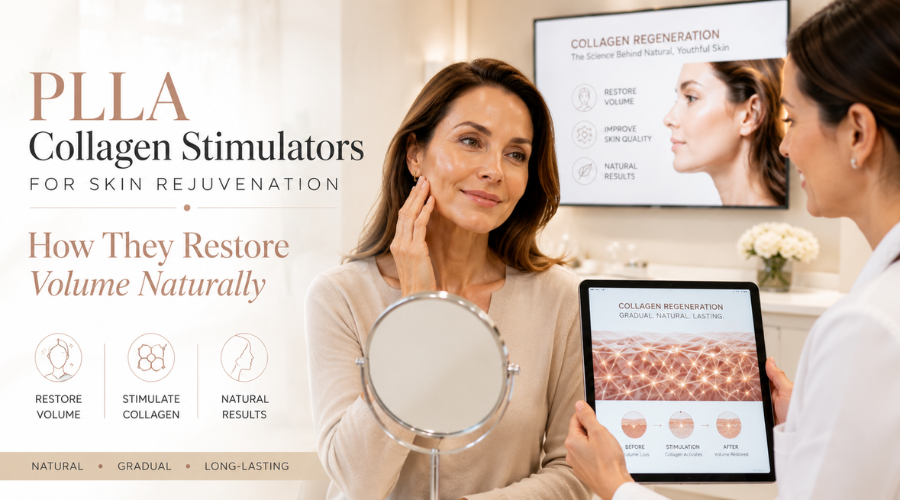
A PLLA collagen stimulator doesn't fill up the space. It regenerates your skin up. It gives the message to the body to start producing the collagen again. This isn't the same old injectable routine. It's different. And that difference matters.
If you've been searching for a long-lasting dermal filler solution that works with your biology rather than against it, then you're in the right place because in this blog we are going to unpack everything about the P
A PLLA collagen stimulator is not a filler. Not in the traditional sense. Traditional HA fillers add volume directly. They are a gel that enters the skin and puffs things up. It works. But it's temporary. And sometimes, it looks quite fake.
Poly-L-lactic acid (the active ingredient found in brands like Sculptra) is classified as a poly-L-lactic acid filler, but that label undersells what it actually does. It's a biostimulator. It activates your own fibroblasts, which are the cells responsible for collagen production, to rebuild your skin's structural scaffolding.
|
Traditional HA Fillers |
PLLA Collagen Stimulator |
|
Add volume directly |
Triggers your body to build its own volume |
|
Results show instantly |
Results build gradually over weeks |
|
Last 6–18 months |
Lasts up to 25 months |
|
Can feel palpable under the skin |
Feels completely natural because it is your own tissue |
|
You're adding foreign gel |
You're rebuilding structural collagen |
The result? Your skin gets thicker, that is firmer and more elastic. Not because something was injected into it but because your body created something new. This is the core value of collagen-stimulating injections: regeneration, not replacement.
You can take a look at clinical stats to see that this injection brings about a natural transformation.
• Dermis thickness increased by 26.1% after a full treatment course was completed
• Adipose (fat) layer thickness increased by 27.0% measured at the 9-month mark
• Elastin production increased by 34%. This is the protein responsible for skin snap-back and recoil
These aren't surface-level tweaks. These are structural changes, and this is what makes PLLA stand out as a legitimate anti-aging injectable treatment rather than just another temporary fix.
Step 1: The Injection
The PLLA microparticles are suspended in a carrier solution. When injected, that carrier provides immediate volume. You'll see it. You'll feel it. Then it goes away. Within two to three days. Don't panic. That's supposed to happen.
The initial volume you see is just the delivery vehicle. The real biological process hasn't even begun yet. This is what makes this a true gradual volume restoration treatment. The visible changes come later, from within.
Step 2: Your Body Rewakens Again
Here's where it gets interesting.
The PLLA microparticles trigger a controlled response from your immune system. This is part of how the PLLA designed. It's called biostimulation.
Two things happen in parallel:
1. Mechanotransduction, which is the physical presence of the particles, mechanically stimulates fibroblasts to start producing collagen.
2. Cytokine signaling, which refers to chemical signals released that ramp up production even further.
The result? Your skin tissue cells begin pumping out Type I and Type III collagen at levels that of younger skin.
Step 3: Neocollagenesis Kicks In
Around 16 weeks after injection, something significant appears: Type III collagen. Also called "baby collagen." It acts as a fresh scaffold beneath the skin a new framework that supports everything above it.
Type I collagen follows shortly after. That's the heavy-duty structural protein. The backbone of firm, youthful skin.
Clinical research has demonstrated that PLLA activates the p38 MAPK signaling pathway, which is directly responsible for stimulating elastin production. This isn't just about plumping, it's about restoring the skin's ability to stretch and return to shape. That's the essence of skin elasticity improvement injections.
Step 4: PLLA Degrades. Your Collagen Stays.
Over six to twelve months, the PLLA particles break down through hydrolysis into lactic acid. Your body metabolizes that into carbon dioxide and water. Harmless. Biodegradable. Gone. And the new collagen? It remains. That's the beauty of this treatment.
Even after the original PLLA has fully degraded, the regenerated collagen fibers continue functioning for a long period. Results persist for 12 to 25 months following a complete treatment course.
PLLA vs. Traditional Fillers: A Detailed Comparison
Let's keep this real. Both options work. But they serve different purposes and different patients.
|
Comparison |
PLLA Collagen Stimulator |
HA Fillers (Juvederm, Restylane) |
|
Mechanism |
Stimulates your own collagen production |
Adds gel volume directly into tissues |
|
Onset of results |
Gradual 4–6 weeks before visible change |
Immediate you see it right away |
|
Duration |
12–25 months |
6–18 months depending on product |
|
Feel / texture |
Indistinguishable from natural surrounding tissue |
Can feel palpable when placed too superficially |
|
Touch test |
Patients report no one can tell anything was done |
Some patients feel subtle bumps or firmness early on |
|
Embolism risk |
Exceptionally low because particles are non-crosslinked |
Higher risk due to cohesive gel consistency |
|
Maintenance schedule |
2–4 sessions per course; annual top-up |
Every 6–18 months for sustained effect |
|
Best candidate |
Moderate-to-severe volume loss plus skin quality concerns |
Focal correction, immediate aesthetic needs |
Here's something most people don't realize: because PLLA is a non-crosslinked material made of microparticles rather than cohesive gel, the risk of catastrophic complications like vascular occlusion or skin necrosis is dramatically lower. In fact, the published literature contains no reported cases of PLLA-induced embolism in patients without HIV.
That's not something you can say about traditional HA fillers.
For anyone considering non surgical facial rejuvenation, this safety profile matters. A lot.
This isn't a one-and-done deal. And honestly? That's part of the appeal. You don't want someone to look at you the day after and say, "Oh, you got work done." You want people to notice three months later that you look amazing and not be able to figure out why. That's the beauty of gradual volume restoration treatment.
The Staged Protocol
|
Session |
What Happens |
|
Session 1 |
1–2 vials are injected. Some temporary swelling. |
|
Wait 4–6 weeks |
Collagen production begins. Subtle changes start appearing. |
|
Session 2 |
Another 1–2 vials. Building on the existing foundation. |
|
Wait 4–6 weeks |
More collagen accumulates. Results become more visible. |
|
Session 3 (if needed) |
Fine-tuning for remaining areas. |
|
Session 4 (if needed) |
Reserved for patients with significant volume loss. |
The amount of correction you achieve depends more on the number of sessions than the volume used in any single visit.
Realistic Timeline of Results
|
Timeframe |
What You Can Expect |
|
Immediately after injection |
Temporary swelling from the carrier solution |
|
2–3 days later |
Swelling resolves. Initial volume disappears. |
|
4–6 weeks in |
First visible signs of new collagen formation |
|
3–6 months after your final session |
Peak results are achieved |
|
12–25 months |
Results are maintained with gradual, natural decline |
This gradual buildup allows your face to regain volume in a subtle, anatomically balanced way. It avoids the overfilled or artificial appearance sometimes associated with traditional fillers.
People notice you look rested. Refreshed. Like you've been sleeping well for six months straight.
That's the goal.
Nothing in aesthetics is zero risk. But the safety profile of PLLA collagen stimulators is genuinely outstanding compared to alternatives.
Who Shouldn't Use It
• Anyone with a confirmed allergy to PLLA, carboxymethylcellulose, or mannitol
• Individuals with a history of keloid formation or hypertrophic scarring
Embolism Risk
This is a risk that is present with injectable treatments so it is important to shed light on it. PLLA is a non-crosslinked suspension of microparticles rather than a cohesive gel, the consequences of accidental intravascular injection are far less severe. Even if particles enter a blood vessel, they are too small and dispersed to cause the kind of catastrophic occlusion that HA fillers can trigger.
Published literature shows no reported cases of PLLA-induced embolism in patients without HIV.
Best Practice Before Treatment
• Baseline photographs should be taken for fair comparison later
• Your provider should assess facial asymmetry and existing volume differences
• Avoid unnecessary herbal supplements that increase bruising risk
• Do not stop prescribed anticoagulants without consulting your prescribing physician
What to Expect After Treatment
• Temporary swelling is normal and resolves within two to three days
• A follow-up assessment at two to four weeks tracks your progress
• The 5-5-5 massage rule helps distribute particles evenly: five minutes of massage, five times per day, for five days
Not everyone. And that's okay. Honest candidacy matters.
You're a Good Fit If You Have:
• Moderate-to-severe facial volume loss in the cheeks, temples, jawline, or lower face
• A preference for natural, gradual improvement rather than instant change
• A desire to use your own biological tissue rather than synthetic gel
• Interest in results that last years, not months
• Willingness to commit to a staged treatment over several months
You May Not Be Ideal If You:
• Need immediate, dramatic correction for an upcoming event
• Cannot tolerate waiting for gradual results
• Have active skin infections or confirmed allergies to PLLA ingredients
Let's talk money. Because it matters and because pricing in the US can vary wildly depending on where you live, who you see, and how many vials you need.
|
Cost Factor |
Estimated Range (US Market) |
|
Per vial (Sculptra / PLLA) |
$800–$1,200 |
|
Per session (1–3 vials typically) |
$1,200–$3,000 |
|
Full treatment course (2–3 sessions) |
$2,400–$6,000+ |
|
Annual maintenance (single top-up session) |
$800–$1,500 |
Here's the honest truth: some providers charge by the vial, others charge by the session, and a few bundle everything into one flat "treatment course" fee. Always ask which model they use before you commit.
Now let us take a long-term view.
Cost per month calculated over a two-year treatment cycle:
|
Treatment Approach |
Monthly Cost |
|
PLLA course (lasting up to 25 months) |
$100–$250 per month |
|
HA filler (requiring touch-ups every 9–12 months) |
$150–$350 per month |
The longevity of results means the cost per month actually compares favorably with regular hyaluronic acid filler treatments, especially when you factor in that PLLA continues improving your skin's structure even after the last session.
You're not paying for gel. You're paying for structural regeneration. That's a fundamentally different value proposition. For anyone seeking a long lasting dermal filler solution, the math often works in PLLA's favor over time.
Not all injectors are equally skilled. And PLLA requires specific technique that differs significantly from traditional filler placement.
What to Look For
|
Criteria |
Why It Matters |
|
Board certification |
Dermatology or plastic surgery credentials indicate advanced training |
|
PLLA-specific training |
PLLA requires deeper injection planes and different dilution protocols than HA fillers |
|
Portfolio of results |
Look for natural, gradual transformations — not overcorrected faces |
|
Transparency about timelines |
A good provider discusses realistic expectations, not best-case scenarios |
|
Honest candidacy assessment |
They should tell you if you're not a good candidate |
Here's what you need to remember. You're not looking for a quick fix. You're looking for something that works with your biology. Something that restores what you've lost naturally and gradually.
A PLLA collagen stimulator does exactly that. It's not the easy choice. It requires more sessions. More patience. More trust in the process. But the reward? Skin that looks like your skin but just better. Fuller. Firmer. More alive. More elastic. The research supports it. The clinical data is crystal clear. Thousands of patients have proven it works.
Whether you're exploring poly-L-lactic acid filler options for the first time or you're ready to move beyond temporary fixes into true regenerative aesthetics this treatment represents a fundamentally different approach to facial rejuvenation.
Q: How is a PLLA collagen stimulator different from a regular filler?
A: Regular fillers add volume directly into the tissue. PLLA teaches your body to produce its own volume. Results take longer to appear but last significantly longer and feel completely natural because they're made from your own collagen.
Q: Is this safe as an anti-aging injectable treatment?
A: Exceptionally safe. Poly-L-lactic acid has been used in medicine for decades in absorbable sutures, orthopedic implants, and soft tissue reconstruction. The embolism risk is dramatically lower than HA fillers, with zero reported cases in non-HIV patients.
Q: How many sessions of collagen stimulating injections will I need?
A: Typically two to four sessions, spaced four to six weeks apart. Your provider will assess your response after each session and adjust the plan accordingly.
Q: When will I actually see results from this gradual volume restoration treatment?
A: Real, noticeable results appear at four to six weeks. Peak results occur at three to six months after your final session. Patience is rewarded.
Mesotherapy is rapidly gaining popularity. Clinics all over the glob...
READ FULLYou’ve probably tried the diets. The extra workouts. Maybe eve...
READ FULLSourcing PLLA fillers requires a lengthy procedure, and the efforts ...
READ FULL